What's new

Alternator not charging

chromecarz00

New member
So I got this new AL82N alternator and it isn't working. I read that the bulb in the dash needs to be running and hooked up for the alternator to work and charge. Problem is, I don't have a standard VW dash and am running VDO gauges. What's the workaround for this?
 

Brett Proctor

Well-known member
Install a light bulb in the system.

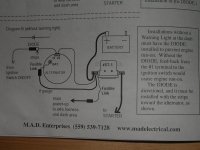
I've read on the web that BMW put a resistor instead of a light bulb in some of their car but couldn't find any solid info on how to do it. Most comments are just guesses at how to do it

Found this
DSCN0962-vi.jpg
 

Brett Proctor

Well-known member
Found a Delco TSB for bench testing the alternator.

They state to use a 10ohm resistor rated at 6 watts or more between No. 1 terminal and the battery for bench testing the alternator.

So I'm guessing that will work in the car
 

nbb350

Active member
You can still use the LED warning light, just put the diode and resistors in parallel with it. That's what I did (not that my car has been running ever in order to test my wiring!) Resistance on an LED is like 1,000,000 ohms, so most of the current will still go thru the resistors anyways.
 

B57-1974

Member
Referring to the MAD diagram on the previous page, when you turn on the ignition key and the car is not running, do you have +12.6VDC on BAT, #1 and #2 terminals? All three terminals are live?
 

Brett Proctor

Well-known member
Referring to the MAD diagram on the previous page, when you turn on the ignition key and the car is not running, do you have +12.6VDC on BAT, #1 and #2 terminals? All three terminals are live?


This is my bad.

Like so many others reading posts I just quickly went through his first post and missed the key element

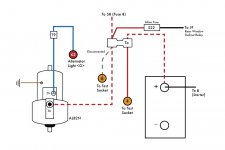
He states he has a Bosch AL82N Alternator, so the wiring should look something like this.

If your not sure if its good you could take it to an auto part store that tests alternators and have them test it. Around here they do it for free. If it tests good then you know the problem is at your end


AL82N alternator.jpg
 

chromecarz00

New member
Just realized that my alternator ground is wired to a screw on the body. I tried to loosen the appropriate screw but it is tighter than any other screw I've seen. It seems to be pretty tight.

I was able to use a bulb I had lying around to get power from B+, but not D+ - this should indicate a bad alternator, yes?

I will try to get it out to test at a local store anyway.
 

B57-1974

Member
The alternator B+ is hooked to the positive terminal of the battery. You should always have voltage there whether the alternator is spinning or not. The voltage at B+ should be +12.6VDC when not spinning and +13.8VDC to +14.2VDC when spinning.

The D+ is used to provide excitation current to get the alternator working at low speed. Many alternators will self-start if you rev the RPMs up to 3000 or so. D+ lights up the warning light because it is at ground potential when the alternator is not spinning. Once the alternator is putting out voltage, the light goes out because you now have the same voltage on both sides of the light and no current flows.

Put a voltmeter on B+ and leave it there. Before you start the engine, you should see +12.6VDC. Now, start the car and check the voltage again. If it is still +12.6VDC, your alternator is not working. Take a piece of wire and connect B+ to D+ momentarily and see if B+ jumps up to +13.8VDC to +14.2VDC. If it does, your wiring going to D+ is faulty. If it doesn't, you probably have a defective alternator. Definitely make sure you have a good ground on the alternator. A bad ground can cause faulty operation as well.
 
Top